
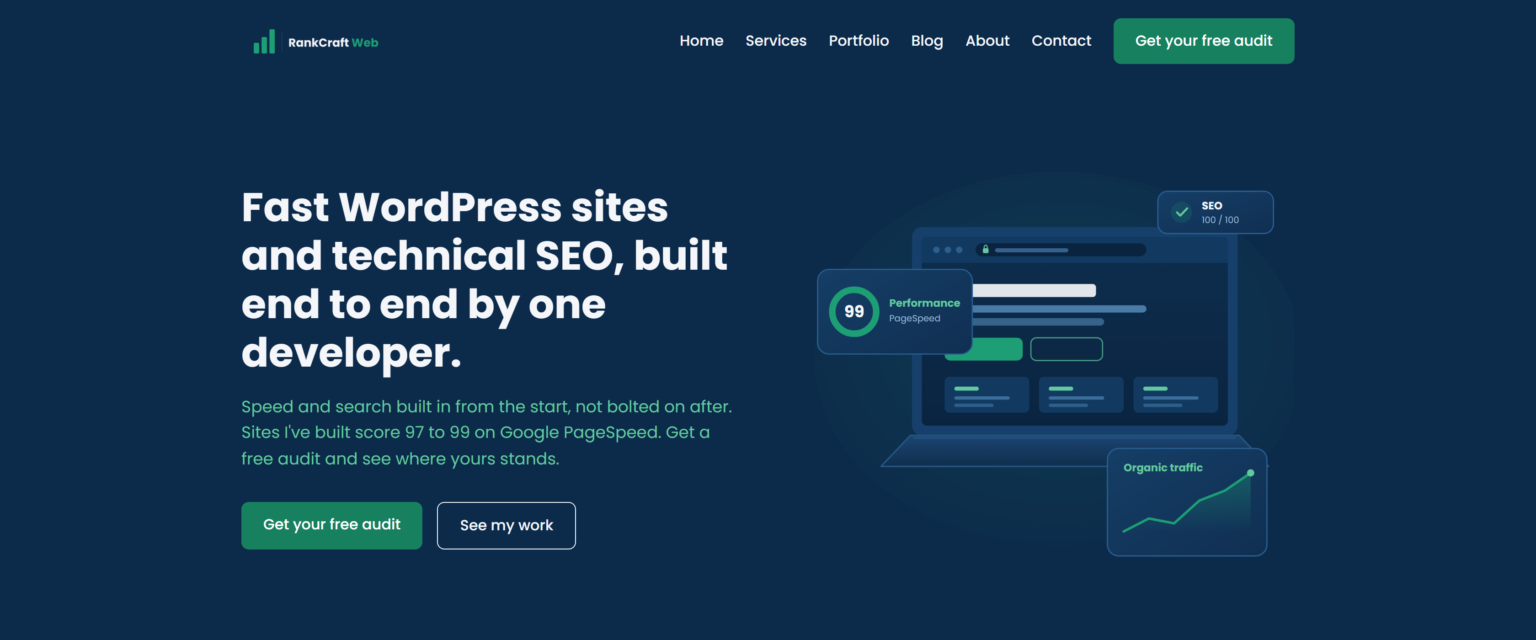
RankCraft isn’t just a service brand, it’s also a working example of what I build. This case study covers the ecosystem itself: the website you’re reading this on, the free audit tool that generates leads, and the system that tracks them, all designed, built, and deployed by me, solo.
The challenge
Most case studies show finished client work: screenshots, links, maybe a testimonial. That proves I can execute a brief. It doesn’t show what happens when there’s no brief at all, when I have to define the problem, design the solution, and ship every part of it myself.
So this case study covers a different kind of project: one where RankCraft is both the builder and the client.
What I built
RankCraft Web
A custom-coded WordPress theme, no page builder. Hand-built templates for the homepage, About, Contact, and a case study system with a custom post type and meta box for client stats, no ACF dependency. Full pre-launch audit covering SEO, performance, accessibility, and security before it went live.
RankCraft Audit
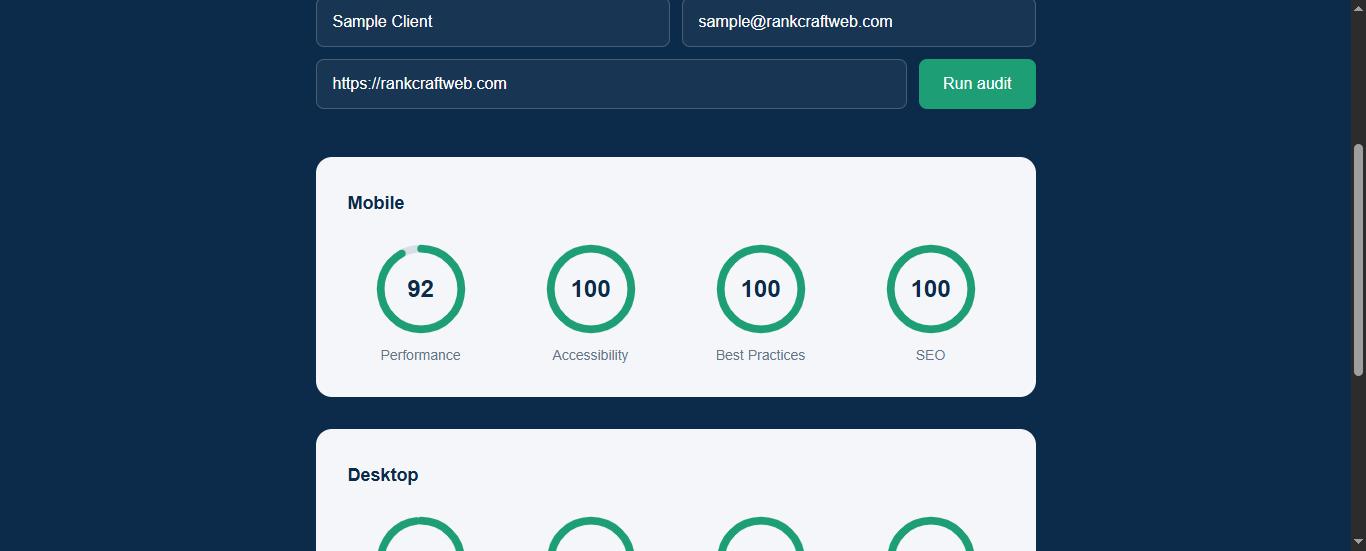
A free website audit tool, the ecosystem’s lead magnet. Built with Next.js and deployed on Vercel as its own product on its own subdomain, not just a page bolted onto the main site. It calls Google’s PageSpeed Insights API server-side, so the API key never reaches the browser, and returns real performance, accessibility, best practices, and SEO scores for both mobile and desktop.
RankCraft Business System
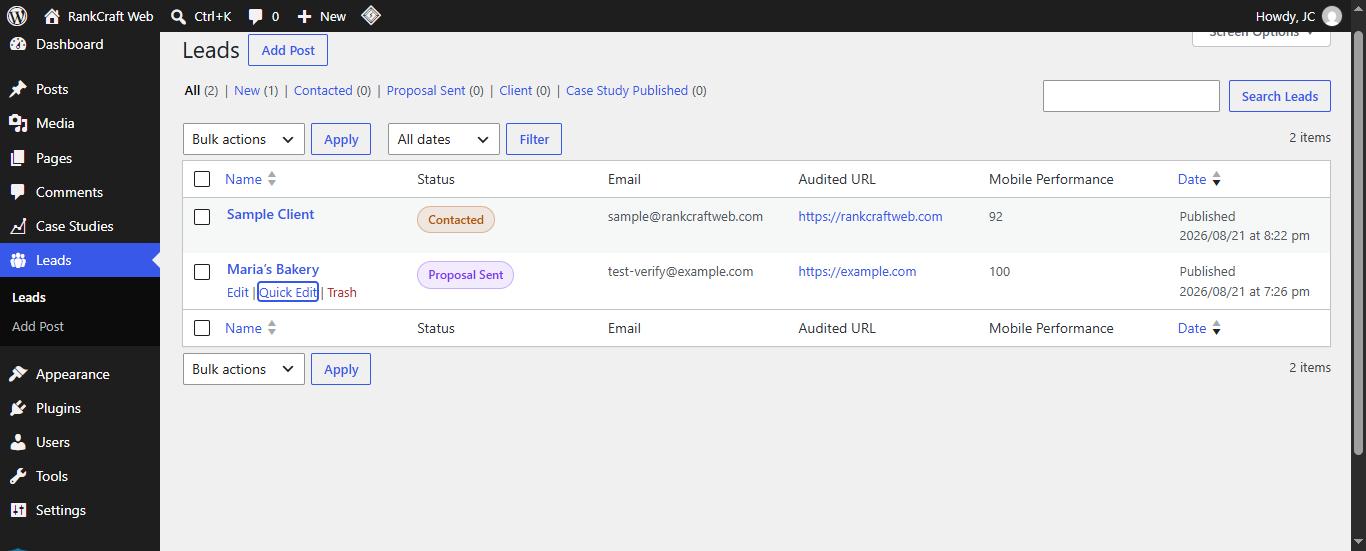
The connective tissue. When someone runs an audit, their name, email, and scores are captured and sent server-to-server to a custom leads endpoint on RankCraft Web. Each submission becomes a Lead with a status pipeline (New, Contacted, Proposal Sent, Client, Case Study Published) that I can update inline from the WordPress admin, no separate CRM software required.
How it connects
A visitor lands on RankCraft Web and clicks “Get your free audit.” That sends them to RankCraft Audit, a completely separate application on its own subdomain. They submit a URL along with their name and email. The tool runs the audit, shows them their results immediately, and in the background posts their details to RankCraft Web’s REST API. That data appears instantly as a new Lead in the WordPress admin, ready to work.
No manual data entry. No third-party form plugin. No Zapier subscription stitching things together. Just two codebases talking directly to each other.
Tech stack
WordPress (custom theme, PHP, no page builder), Next.js, TypeScript, Tailwind CSS, Vercel, Google PageSpeed Insights API, Hostinger, Git and GitHub for both codebases.
Why this matters
Any developer can point to a client site built from a brief. This is different: a working product ecosystem, three separate pieces and three different technical decisions, designed as one connected system. It’s the clearest example I have of how I approach a project end to end, from architecture down to the deployment pipeline.
Since it’s a real, live site rather than a mockup, you can check the numbers yourself: RankCraft Web currently scores 97 desktop / 80 mobile performance and 100 accessibility, best practices, and SEO on Google PageSpeed Insights. Run the audit on it directly to see the current numbers.